Meet the world of tomorrow
From bioprinted body parts to a space elevator, what to look forward to by 2050
Meet the world of tomorrow
Meet Tomorrow is created in collaboration with futurologist Tom Cheesewright and award-winning science fiction author and former astrophysicist Alastair Reynolds. The campaign sets out to create hope about the future at a time when only 17% of UK adults feel optimistic. Through this we explore the extraordinary innovations that could transform our lives by 2050.
What will life look like in the middle of the century?
According to Tom Cheesewright, the next 24 years will bring breakthroughs that sound like science fiction today but will soon become reality. These predictions come to life in Reynolds’ short story ‘Meet Tomorrow’, which imagines a future where optimism drives innovation. The future is closer than you think, and brighter than many dare to imagine.

Healthcare
Healthcare will be revolutionised as 3D bioprinters create organs using patients’ own cells.

Space travel
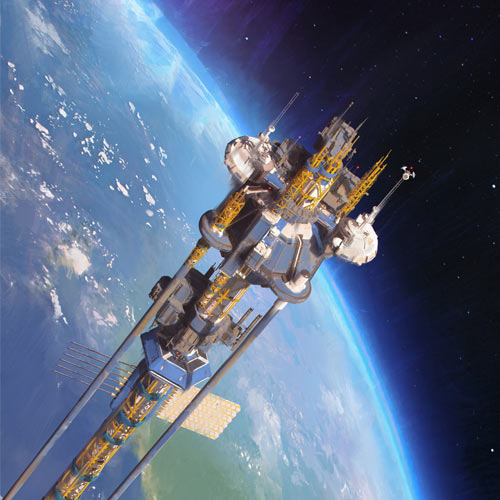
Space travel will take a giant leap forward with the construction of the first space elevator.

Back on Earth
Back on Earth, android assistants will become affordable and commonplace, taking care of household chores and even providing companionship.

Wearable tech
Perhaps most surprisingly, the smartphone era will end. Smart glasses will replace handheld devices, while ultra-thin screens will blend seamlessly into our homes, turning walls into high-resolution displays.
Discover the story
Hear from Alastair Reynolds as he shares his vision for the future.
As a science fiction writer, I've often tried to lean into the optimistic science prediction. Science fiction gives us that that language to begin thinking about the challenges we're going to face in the future.
When I began shaping Meet Tomorrow, I look closely at Tom's predictions. One of the ideas that I really liked was the notion of bioprinting. The idea that in the future, when you have some kind of illness, it'll actually be easier to 3D print an organ from your own genetic template and then have it put back into you. And Tom even spoke about the possibility of having eyes 3D printed.
The notion of a space elevator is something that's always fascinated me, and I first encountered it in the work of Arthur C. Clarke. The idea that you can lower a cable down from geosynchronous orbit to the Earth and then use it to transfer cargo and people up into space.
With a growing population and an ageing population, I can imagine that companionship, even robot companionship, may become really important to people. So I was keen to introduce the concept of an Android companion and show how it could assist someone.
If we think back 25 years, things like smartphones, Wi-Fi, video calling, streaming, real time translation, digital assistants, all of these things were essentially science fiction. But now we barely give them a second thought. They're just part of the furniture.
One of the things that science fiction can do is offer us some hope that there are many exciting developments heading our way in science, technology, medicine, engineering, exploration.
Zurich has an optimistic view of the future. I think if we're going to make great things happen, we have to have that optimistic mindset as well. So I'm excited about the road between here and 2050.


For a flipbook of the short story, visit:

What do our experts think about the future?

Alastair Reynolds
Award-winning science fiction author and former astrophysicist
“Smartphones, streaming, and digital assistants were science fiction just 25 years ago, yet today they’re part of our everyday lives. Change is inevitable, which makes imagining the middle of the century so exciting. Sci-fi helps us picture the future and our role in it. My aim with this story was to shine a light on a positive vision inspired by Tom’s predictions, because we must imagine a better world before we can innovate it.”

Tom Cheesewright
Applied Futurologist and author
“It’s easy to fear a future dominated by AI and robotics, but history shows human creativity outpaces pessimism. From decoding the human genome to renewable energy breakthroughs, progress is accelerating. Across healthcare, housing, retail, and travel, early signs of transformative change are already here. If we back bold ambitions and harness innovation, the next 24 years could mark the greatest era of human progress in history.”

David Nichols
Head of Retail at Zurich UK
“Innovation drives progress, from infrastructure to emerging technologies, and insurance is its backbone. In essence, it provides the confidence and resilience for risk-takers to pursue bold ideas. If we only focused on potential failures, today’s advancements wouldn’t exist. Insurers enable calculated risks, offering a safety net that empowers innovators to build a better future. Optimism is the practical ingredient that fuels ambition and ensures progress for generations to come.”
Visions of the future
Illustrators Amir Zand and Thomas Dubois created five futuristic illustrations that transform these bold predictions, such as bioprinted body parts and space elevators, into imaginative, visually striking scenes of life in 2050. Through AI innovation, these images were transformed into animations.