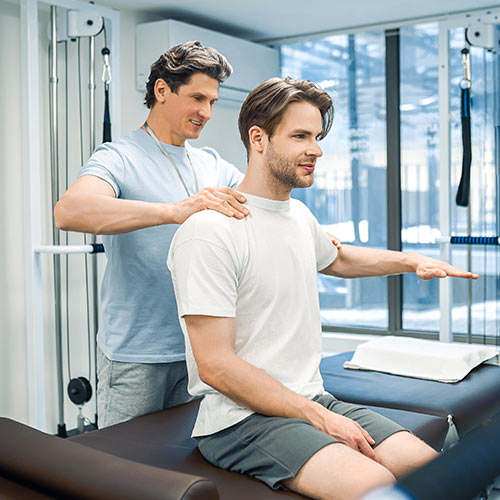
Injury rehabilitation information for employers
Injury rehabilitation support for your employees
We have an in-house group of qualified nurses and allied health professionals who assess and support employees if they sustain an injury directly resulting from a workplace incident. Our team of professionals aim to help you and your business reduce the costs of injuries and accidents at work by ensuring your employees receive appropriate and timely treatment.
Please note: We are unable to offer our rehabilitation proposition in the Republic of Ireland, Jersey, Guernsey, or the Isle of Man, due to differing healthcare arrangements.
If you're involved in a workplace incident that has affected you physically or psychologically, the road to recovery can feel challenging.
- What's the recovery process?
- How long will it take before I can get back to work?
- What if I need treatment but there are long delays on the NHS?
- Who can I speak to for guidance?
Zurich Rehabilitation services are free to you courtesy of your employer.
The Zurich Rehab team is a group of qualified healthcare professionals experienced in managing recovery from injuries and incidents at work. Their goal is to get you back to normal life as promptly as possible, minimising disruption to your lifestyle and work.
At the start of the process, your case will be assigned to a Rehabilitation Case Manager, otherwise known as RCM, who will arrange a video or telephone assessment with you. This helps us to understand what you need and to make sure you have access to the right treatment promptly to ensure you're on a swift road to recovery.
Unlike a private healthcare scheme, if you're receiving treatment through the NHS and all is running smoothly, we will let your treatment continue with them. But if you're experiencing delays, we work with trusted partners who can fast track your recovery through private care, often cutting down recovery times by weeks or months.
It's important that we get your written consent before we can begin treatment. Without it, we are unable to assist.
We understand it's not always easy to discuss medical issues in a second language, so if you would prefer to speak or write in a different language, we can arrange an interpreter to be present at your assessment and help with the translation of documents.
Each case is different, so your RCM will work with you to create a personalised rehabilitation programme to help you achieve your recovery goals.
Throughout your entire rehabilitation journey, your RCM will be a source of advice and support, regularly checking in with you to make sure you stay on the right track.
To get things started, just let your employer know that you would like to be referred to us and we'll take things from there so your personalised recovery programme can begin.
Accessing our injury rehabilitation services
We can offer you and your employees:
- Access to telephone assessments during business hours (9am to 5pm, Monday to Friday) to create a proactive rehabilitation plan
- An innovative approach that combines traditional insurance, risk management, and injury management to expedite employees' return to work and reduce the cost of any arising claims
- Free case management - we do not charge for case management time; instead, we record external treatment costs, which form part of the ongoing claims experience
Making an injury rehabilitation referral
You can make a referral via email or our online portal. See ‘Injury rehabilitation documents’ below for information on the referral/notification process, including guidance on what kinds of injuries are likely to be suitable for the service.
More about our injury rehabilitation support

Mental health support
We aim to provide comprehensive mental health services, including talking therapies, cognitive behavioural therapy (CBT), and eye movement desensitisation and reprocessing (EMDR), to address psychological trauma as well as broader issues that may impact an individual's mental health, such as bereavement support, debt, or relationship issues.

Clinical expertise
Our rehabilitation team takes great pride in adopting a holistic approach, treating each case individually to achieve the best possible outcome for all parties.

Musculoskeletal injuries
Workplace absences are often caused by physical health issues, and we can provide support through a combination of advice and education, self-managed exercise programmes, physiotherapy-supported exercise programmes and the latest digital physical therapy solutions.

Injury rehabilitation case studies
Our tailored care and support have empowered employees to regain their health and confidence, enabling them to resume their normal routines and professional roles.

Jayne’s story
Jayne had residual pain in one of her knees and had self-certified her absence without consulting her GP. Our rehabilitation case manager, Nicky, advised Jayne to speak with her GP to review her treatment.
Following her GP consultation, Nicky referred her for private physiotherapy. Within two days, she had her first physiotherapy session and after assessing the report, Jayne and Nicky agreed she could resume work on light duties alongside her treatment plan.
Previously, Jayne had taken 12 weeks of sick leave without treatment for her knee injury. This time, she returned to work on light duties within five days of her assessment. She was relieved to be back at work so quickly and able to support her colleagues.

William’s story
During a telephone assessment, William’s assigned rehabilitation case manager (RCM) identified that he had residual symptoms consistent with an acquired brain injury.
Although William had returned to work on light duties, his RCM was concerned these residual symptoms – including dizzy spells, blurred vision and disorientation – posed a risk of further injury at work.
The RCM explained why the head injury symptoms were persisting and provided a rehabilitation plan aimed at getting William back to full duties with private intervention, as his GP had confirmed there would be at least a four-month wait for an NHS neurological surgeon appointment.
The RCM liaised with the employer’s HR and occupational health nurse (OHN) to ensure a safe return to work, beginning with office duties, rather than on the factory floor. William was referred to a neurological surgeon on a private basis, and a scan found no brain damage or bleeds. He was then referred to a specialist vestibular ENT consultant, who performed a hearing test that showed no deafness, and then carried out an Epley manoeuvre (a specific set of head and body movements) which instantly resolved the residual symptoms.
Following an interview with his OHN, William was able to return to work on full duties.

Jay’s story
At his telephone assessment, Jay reported that he had been hit on the head and back with crowbars and feared for his life. We identified symptoms that could indicate post-traumatic stress disorder (PTSD) or an acquired brain injury. Jay was unfit for work.
We advised his GP to refer him for an urgent NHS brain scan and referred him to a private therapist for his PTSD symptoms.
The scan showed no brain damage and Jay continued with psychological therapy. We also referred him for private physiotherapy to address his persistent back pain. Jay made a full recovery with physiotherapy, but his psychological therapy was extended to support his return to work. We liaised with his employer’s HR to advise and support the management of his return to work.
As Jay began his phased return to work, the Covid-19 pandemic impacted his situation, leading to furlough and subsequent staff redundancies. Both his HR and Jay felt that, having completed his psychological therapy and with a solid rehabilitation programme, he was well-prepared to make informed decisions about his future with his employer.
Although Jay was made redundant due to the impact of Covid-19, he was work-ready and fit to apply for new positions with different employers.
Injury rehabilitation FAQs
Find answers to frequently asked questions about our injury rehabilitation support.


