Urban Climate Resilience Program
Our support
The Urban Climate Resilience Program (UCRP) was launched by the Z Zurich Foundation (ZZF) in early 2023 with the aim to build sustainable, resilient communities – communities that can withstand, recover from and thrive in the face of climate related disasters.
In the UK with support from the Z Zurich Foundation, we are working with Resilient Cities Network in Greater Manchester to support communities facing challenges such as flooding, extreme heat and rising living costs.
The programme brings together residents, local authorities, businesses and community organisations to develop practical, community-led solutions that strengthen resilience and improve wellbeing.

What we are doing in Greater Manchester?
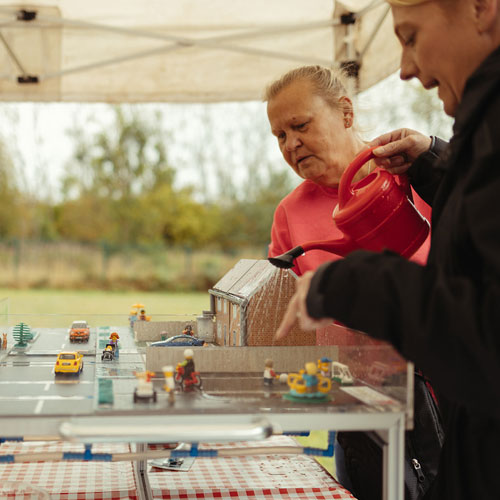
In Greater Manchester, the project has partnered with local residents, community organisations and local authorities in Edgeley and Higher Folds to deliver practical climate resilience improvements. This includes refurbishing a formerly disused council property into a hub for climate resilience-focused community programming in Edgeley and support for a community garden, urban greening efforts and a sustainable urban drainage plan to help manage extreme heat and heavy rainfall in Higher Folds.
Alongside physical improvements, the project has supported community engagement, knowledge sharing and local leadership to help residents better prepare for climate-related risks and build long-term resilience.
Learn more about how Zurich, Z Zurich Foundation and Resilient Cities Network are supporting resilient communities in Greater Manchester.
Raising community resilience in Greater Manchester
The last time the floods at the bottom of the estate happened, everyone was for everyone. All the people who couldn't leave the houses, people were ordering them in food, treading through the water to ask if they need help.
So this community is as close knit as you can get. Everyone around is so much more of a family than the family I've actually had. They've helped me, they've supported me, they've brought me up.
Every time we have a flooding, the full community of Higher Folds, we all come together. We just all, as one unit, we just turn into like one person altogether.
Having lived there for so long, I feel that I've got some sort of responsibility to make sure that people are safe and happy.
It really is a lovely community in Edgeley, and people do pull together. People have mentioned about the heatwaves we've had. I know in here we really struggled. We had to shut up shop actually when we had the heatwave, and it was the extreme temperatures.
I feel pretty helpless really and trying to help other people. As you know, I work here to help other people, but on that case I don't think there's anything I could do.
There's a saying, isn't it? You know, if it walks like a duck, talks like a duck, quacks like a duck, then it's probably a duck in it. So it’s a duck, climate change is real.
Resilience for Communities is all about working with communities. I think sometimes when we do resilience projects at this city level, communities can feel like things are being done to them. And actually we want to switch that round and do things with communities.
So looking to implement solutions, whether that's nature based, social, infrastructure solutions that look at the climate issues that come from those conversations. So it's putting something in place to make communities more resilient to climate.
If as a community they listen to what we want, then I feel it could completely change people's lives. I think there's a lot of opportunities that can be created.
I think people have lost a lot of faith because there's not been as much help there to help people achieve the goals that they have for the estate. But now that I think if people realise that there's help that can be given, there'll be a lot that can change for the better.
Because some things that we need to do aren't just down to individuals. They have to have some incentive. You have to have a little bit of money to get people motivated.
I worry about it to my grandchildren. I think we need to do a hell of a lot more than we're doing for the environment. I don't think we're doing even 2%. We should be doing much, much more.
The community members really surprised me because at the beginning of the program, I knew about these communities from their statistics of employment, income and social status. And it doesn't paint a very pleasant picture. But when you talk to the residents themselves, they're full of hope. And they're very inspiring people because even if they're having a tough time, they have a lot of empathy for others, a lot of trust in each other. And it's really, really nice to see.
Through this engagement work we want to understand people's perceptions, the impacts that extreme weather have and then building that towards implementing some sort of solution, something in that's positively impacting them.
At this point, it really is a case of just understanding what works in a community to engage the community and also just kind of adapting. We all need to adapt to the programme and we have to adapt to climate change and have to adapt to the people that we're working with.
I was quite excited to hear about this project as it was based within communities , it wanted to hear the opinions of people.
I think the project is absolutely brilliant because it's looking at the future and it's a future that appears to be arriving even a bit quicker I think than everybody expected.
I think in terms of climate action, everyone has been very much focused on the mitigation of greenhouse gas emissions and reducing the impact that we have on the environment, what's really important about the R4C work is it's starting to look at adaptation and how the environment will be impacting on us over the next coming decades.
The fact that people are actually investing time and experience and hopefully some money into improving this area and hopefully improving the floods and the issues that are also on the estate, it's going to be a good thing, isn't it?
So we're about one year into this program, which is due to last around about three years and we're just coming to the conclusion of our research phase. So we've been talking to key stakeholders within Wigan and Stockport, lots of technical experts, almost 500 members of the community we’ll analyse the data, and then we get into the really exciting bit, which is where we get to kind of co-design solutions and begin to implement something which will have impact.
Looking ahead
Over the next three years, the programme will expand its work across Greater Manchester, supporting more communities to become resilient to flooding, extreme heat and other climate-related risks. The learning and approaches developed will help shape local resilience planning and provide a model that can be applied in communities across the UK.